Source maps
Upload your JavaScript source maps so browser error stacks show your original files, functions and code, and so one bug stays one issue across deploys.
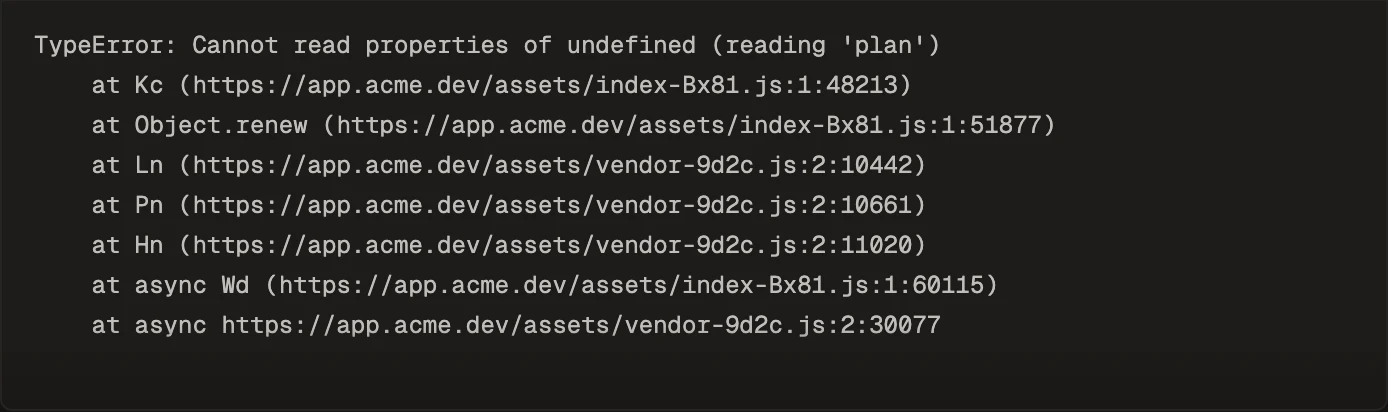
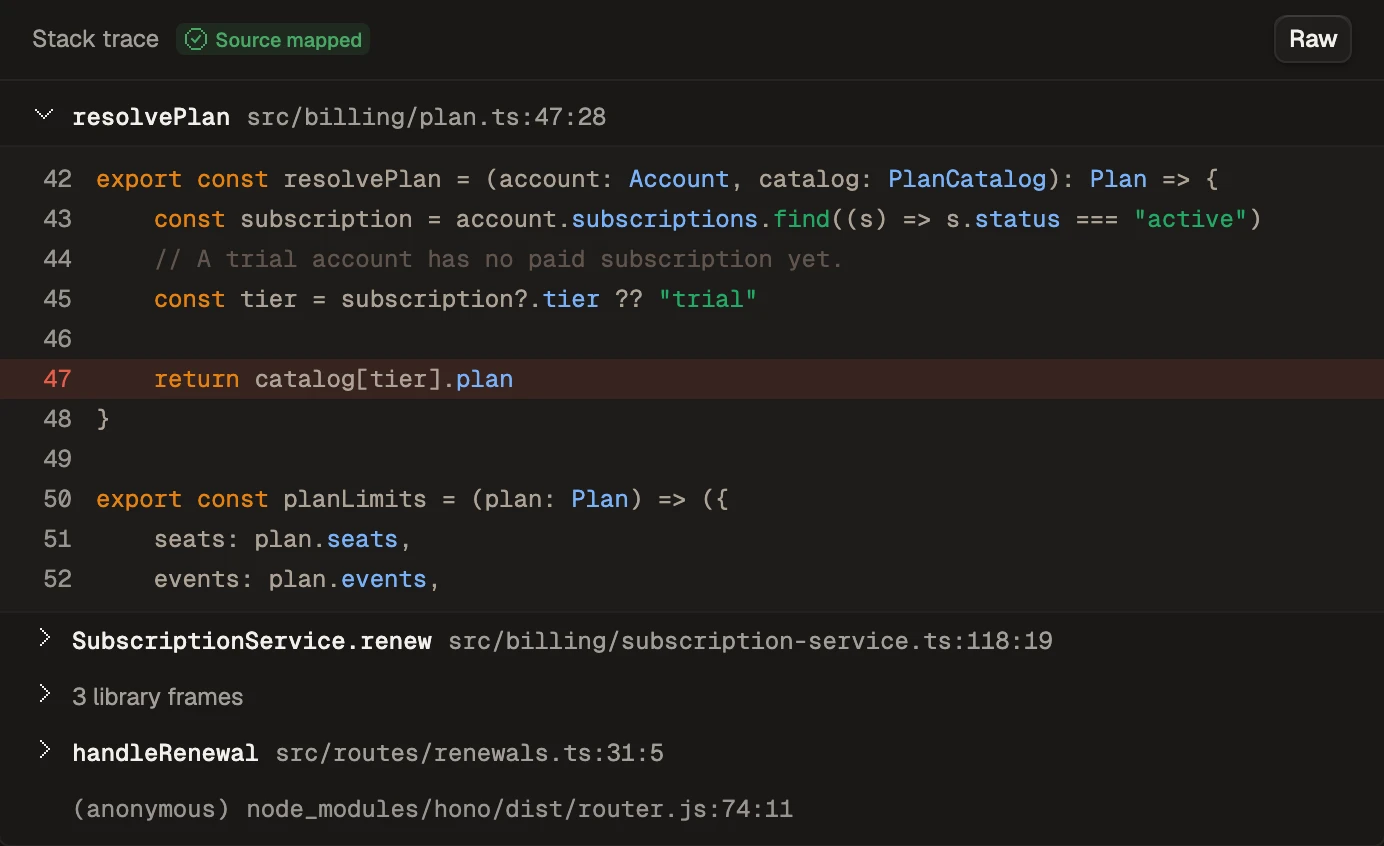
A minified browser bundle reports errors from files like assets/index-Bx81.js at line 1, column 48213, inside a function called Kc. Upload the build’s source maps and Maple maps each stack frame back to your original file, function, line and column, and shows the code around it on the issue page.
Maps are read when an issue is shown, never served to your users, and never applied to the stored error: the raw stack is kept as sent.
How a frame finds its map
Maple matches each frame to an uploaded map in one of two ways:
- By debug id (recommended). The Vite plugin or
maple sourcemaps injectwrites a unique id into each built JS file and its map. When the file runs, it registers that id, and@maple-dev/browser0.17.0 or later sends the ids of the scripts in an error’s stack asmaple.exception.debug_idson the exception event. Maple then picks the map by id, whatever URL the file was served from. Ids written by Sentry’s debug id tooling work too. - By release and path. A map uploaded with a service and release is matched to frames from that
service.nameandservice.versionwhose URL path ends with the map’s file path.assets/app.jsmatcheshttps://cdn.example.com/, butstatic/ assets/ app.js app.jsdoes not matchassets/myapp.js. Use this when your telemetry reports no debug ids.
Release matching needs service.version on your telemetry to equal the release you upload under. The CLI defaults the release to the build’s git commit. Either set service.version to that commit, or use one value of your own for both the release and service.version.
Upload with the Vite plugin
For a Vite app, @maple-dev/vite 0.1.0 or later does every step inside vite build. It needs Vite 6 or later.
npm install -D @maple-dev/vitepnpm add -D @maple-dev/vitebun add --dev @maple-dev/vite// vite.config.ts
import { mapleSourceMaps } from "@maple-dev/vite"
import { defineConfig } from "vite"
export default defineConfig({
plugins: [
mapleSourceMaps({
service: "web",
release: process.env.GITHUB_SHA,
}),
],
})When the build finishes, the plugin:
- Turns on hidden source maps (
build.sourcemap: "hidden") when the setting is unset or off, so no publicsourceMappingURLcomment is written. - Injects a debug id into every built JS file.
- Moves the maps out of the deployed output into
.beside your Vite config, so they are never served.maple/ sourcemaps/ < name of the build's output folder> - Uploads them to Maple.
In CI, set MAPLE_API_KEY for the build step. It is an API key with the Source maps write scope (source_maps:write), created by an engineer or admin under Settings → Keys. The plugin reads MAPLE_API_KEY, not the MAPLE_API_TOKEN the CLI reads.
- run: npm run build
  env:
      MAPLE_API_KEY: ${{ secrets.MAPLE_API_KEY }}
Without a key, or without service, the plugin logs a warning and keeps the maps in .maple/sourcemaps, so a local build works with no setup. Add .maple to your .gitignore.
| Option | What it does |
|---|---|
service |
The service.name your app reports. Required to upload. |
release |
The service.version your app reports, such as a commit SHA. Required with matchBy: "release". There is no default. |
apiKey |
The API key. Defaults to MAPLE_API_KEY. |
apiUrl |
The Maple API base URL. Defaults to MAPLE_API_URL, then https://api.maple.dev. |
urlPrefix |
The path the files are served under, prepended to each file path. Set static/ when dist/app.js is served as /static/app.js. |
matchBy |
"debugId" (default) for @maple-dev/browser. "release" uploads without debug ids, for telemetry that reports none. |
upload |
Set false to only inject debug ids and move the maps, and upload them another way. |
failOnError |
Set true to fail the build when an upload fails. By default a failed upload logs a warning and the build finishes. |
mapsDir |
Where the maps go, relative to the Vite root. |
environments |
The Vite environments whose output is processed. Defaults to ["client"], the browser bundle. |
Maps upload four at a time. A request that gets a 429, a 5xx or no response is retried up to 4 times.
The plugin skips a map with a warning when:
- The map is over 10 MiB.
- The map is an index map (one with
sections). - The map maps no sources.
matchBy: "release"is set without arelease.- The map’s file has no debug id and no
releaseis set.
failOnError covers failed uploads and maps that cannot be read. A missing key or service, and skipped maps, only warn.
On the first build with the plugin, a chunk whose hashed name did not change gets new contents, because the debug id goes in after the file is named. A browser or CDN that cached that chunk may serve the old copy for that one release. Later builds are deterministic.
Upload with the CLI
Use the Maple CLI 0.6.0 or later in your CI, after the build and before the deploy.
-
Build with source maps on. With Vite, set
build.sourcemap: "hidden"so no publicsourceMappingURLcomment is written. Other bundlers have an equivalent setting. -
Inject debug ids into the build output:
maple sourcemaps inject distEvery JS file that has a map gets a debug id, derived from the file and its map, so re-running changes nothing. Add
--dry-runto see what would change. -
Upload the maps:
maple sourcemaps upload dist --service web -
Deploy
distas usual. Delete the.mapfiles from it first if you do not want them served.
upload needs a signed-in workspace: run maple auth login, or set MAPLE_API_URL and MAPLE_API_TOKEN in CI. The token is an API key with the Source maps write scope, created by an engineer or admin under Settings → Keys.
| Flag | What it does |
|---|---|
--service |
The service.name your app reports. Needed for maps without a debug id. |
--release |
The service.version your app reports. Defaults to git rev-parse HEAD in the build directory when --service is set. |
--url-prefix |
The path the files are served under, prepended to each file’s path in the build directory. Set it when dist/app.js is served as /static/app.js. |
The command uploads one map per JS file, four at a time, and prints each one. It skips a map with a warning when:
- The map is over 10 MiB.
- The map is an index map (one with
sections). - The map lives outside the build directory.
- The map has no debug id and no
--serviceand--releasewere given.
A run that uploads nothing, or where any upload fails, exits non-zero so CI stops.
Upload with Alchemy
If you deploy with Alchemy, @maple-dev/alchemy 0.8.0 or later does both steps for a Vite app. The Vite plugin turns on hidden source maps, injects debug ids, and moves the maps out of the deployed output into . beside your Vite config, so they are never served. An app that does not deploy with Alchemy uses @maple-dev/vite instead.
// vite.config.ts
import { mapleSourceMaps } from "@maple-dev/alchemy/vite"
import { defineConfig } from "vite"

export default defineConfig({ plugins: [mapleSourceMaps()] })
The Maple.SourceMaps resource uploads them after the build:
// alchemy.run.ts
Effect.gen(function* () {
	const web = yield* Cloudflare.Website.Vite("web")
	yield* Maple.SourceMaps("web-sourcemaps", {
		// This Website builds to dist/client. A plain Vite build uses .maple/sourcemaps/dist.
		dir: ".maple/sourcemaps/client",
		service: "web",
		release: process.env.GITHUB_SHA,
		after: web.hash,
	})
})| Prop | What it does |
|---|---|
dir |
The plugin’s maps directory, or any build output where each JS file has its map beside it. |
service |
The service.name your app reports. |
release |
The service.version your app reports. Required with matchBy: "release". |
urlPrefix |
The path the files are served under, such as static/. |
after |
Any value from the build, such as the Website’s hash. It orders the upload after the build and re-checks the maps when it changes. |
matchBy |
"debugId" (default) for @maple-dev/browser. "release" uploads without debug ids, for telemetry that reports none. |
The resource uploads again only when the maps or its props change. Deleting it deletes no maps, because earlier releases still need them.
The plugin options are mapsDir, where the maps go, and environments, the Vite environments to process (default ["client"], the browser bundle). The plugin runs in Node and needs @effect/platform-node.
On the first deploy with the plugin, a chunk whose hashed name did not change gets new contents, because the debug id goes in after Rollup names the file. A browser or CDN that cached that chunk may serve the old copy for that one release. Later builds are deterministic.
Upload with the API
POST /v2/source_maps takes one map as the raw request body (application/json or application/octet-stream). Identify it with query parameters:
| Parameter | Required | Meaning |
|---|---|---|
minified_path |
Yes | The JS file’s path relative to the deploy root. |
debug_id |
Either this, or service and version |
The debug id written into the JS file and its map. |
service |
The service.name. |
|
version |
The service.version. |
curl -X POST "https://api.maple.dev/v2/source_maps?minified_path=assets/index-Bx81.js&service=web&version=1.4.2" \
  -H "Authorization: Bearer $MAPLE_API_TOKEN" \
  -H "Content-Type: application/json" \
--data-binary @dist/assets/index-Bx81.js.map- A map must be a version 3 source map with a non-empty
sourcesarray. Index maps (sections) are refused with a 400; emit a regular map. - Maps over 10 MiB are refused with a 413. 10 MiB is the largest map Maple can symbolicate with.
- Uploading a map with the same debug id replaces it. Uploading a map without a debug id for the same service, version and path replaces it too.
GET /v2/source_maps lists your maps, filtered by service, version or debug_id. DELETE /v2/source_maps/{id} deletes one. Any member can list; uploading and deleting take an engineer or admin and the source_maps:write scope. See the API reference.
On the issue page
The Stack trace on an issue’s Overview shows the mapped frames, top of the stack first, under a Source mapped marker, or Partly source mapped when only some frames found a map. Your own frames open on the code around the line when the map embeds sourcesContent. Runs of library frames fold into one row. Raw switches to the stack exactly as it was sent.
Frames count as library code when their original path is under node_modules/, is webpack runtime code, a browser extension or <anonymous>, or when the map’s ignoreList marks their source.
Grouping on mapped frames
When an organization has source maps, a browser error that groups on its stack frames uses the mapped frames. Each in-app frame counts by its original file and function, never a line or column, so a fix elsewhere in the file does not split the issue. A frame with no recovered function name uses its file plus the text of its original source line.
A stack that maps nothing groups as before. maple.fingerprint and your organization’s grouping rules still come first.
- The first map your organization uploads re-groups its browser errors once, as they recur. Issues that deploys had split can then join one issue.
- An error whose stack carries a debug id waits up to 1 hour from its first sighting for its map before it is grouped. Upload maps in the same pipeline step as the deploy, so they arrive before the first error.
- A map uploaded later than that does not re-group errors already grouped on the raw stack.
Retention and limits
| Limit | Value |
|---|---|
| Largest map | 10 MiB |
| Map formats | Version 3 regular maps. Index maps are not supported. |
| Retention | A map not used to resolve a stack for 90 days is deleted. |
| Uploading and deleting | Engineers and admins |
The API returns when each map last resolved a stack, to the day, as last_used_at.
Troubleshooting
- Stacks still show minified code. Check that the maps uploaded (
GET /v2/source_maps). With debug ids, check thatinjectran on the same files you deployed, after any step that rewrites them, and that your app uses@maple-dev/browser0.17.0 or later. Without debug ids, check thatservice.versionon the errors equals the uploaded release, and that the uploaded path is the end of the URL path (set--url-prefix). - Frames map but show no code. The map has no
sourcesContent. Turn on embedding the sources in your bundler. - The build log says
MAPLE_API_KEY is not set. The Vite plugin found no key, so it kept the maps on disk and uploaded nothing. SetMAPLE_API_KEYin the environment of the build step, or passapiKey.MAPLE_API_TOKENis the CLI’s variable and the plugin does not read it. - The build log says
no service is set. PassservicetomapleSourceMaps(). - The build log says
build.sourcemap: "inline"embeds the maps. Inline maps ship inside the served files, so the plugin cannot upload them. Remove the setting or set it to"hidden". uploadskips every file with “no debug id”. Runmaple sourcemaps injectfirst, or pass--serviceand--release.- An error opened a new issue after a deploy. Its map arrived more than an hour after the first occurrence. Upload before or with the deploy.
Next steps
- Errors and issues: how issues are grouped and worked.
- Frontend: set up
@maple-dev/browser. - CLI reference: every
maple sourcemapsflag.